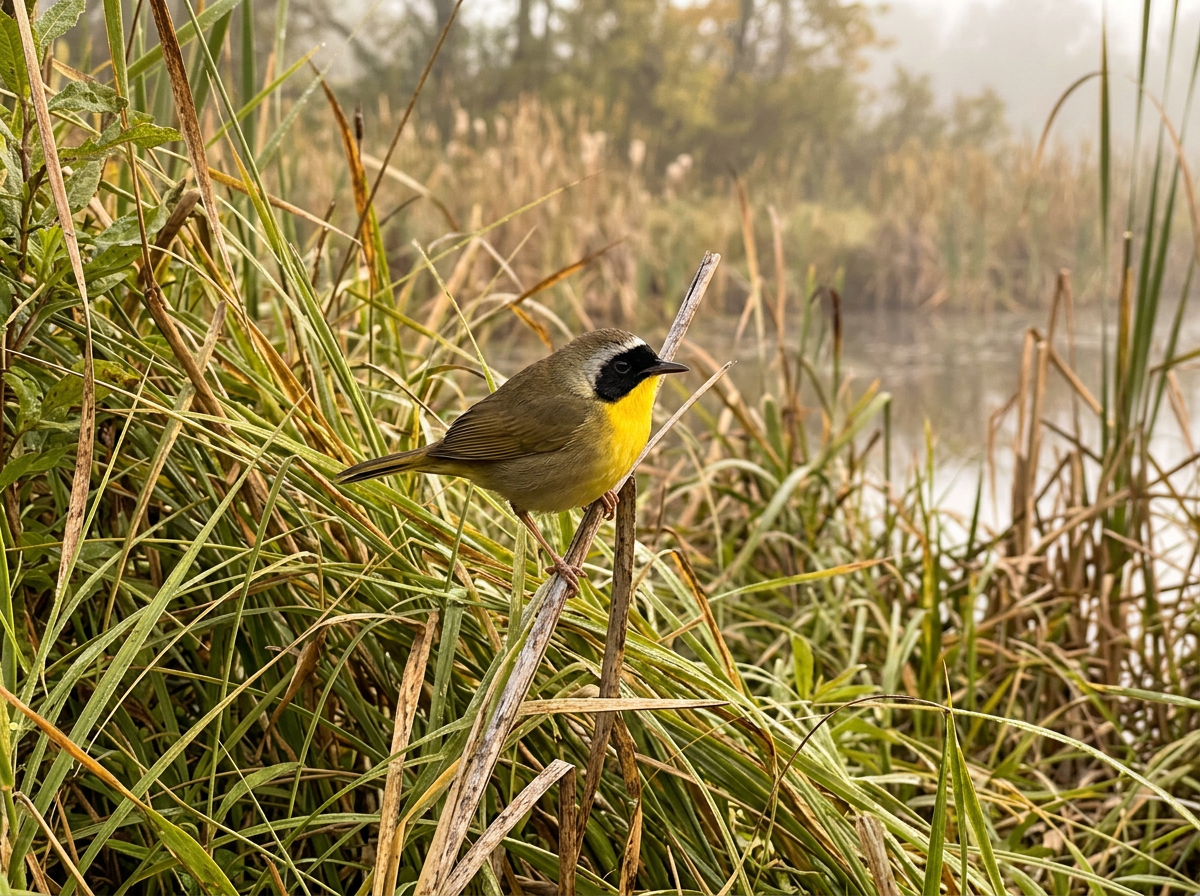
If your bird has white or yellowish patches in its mouth, is drooling, refusing food, or just seems "off" around the beak area, thrush-like infection is one of the first things worth ruling out. In birds, thrush refers to a fungal or yeast-based infection, most commonly caused by Candida, that shows up in the It is not always easy to spot at first glance, and it can look a lot like other problems, which is why knowing what to look for, and how to tell it apart from similar conditions, matters a lot before you call your vet. common thrush bird. It is not always easy to spot at first glance, and it can look a lot like other problems, which is why knowing what to look for, and how to tell it apart from similar conditions, matters a lot before you call your vet.
How to Identify a Thrush Bird: Signs and What to Do

What "thrush" actually means in birds
The word thrush gets used a few different ways in avian medicine, so it helps to understand what people usually mean. In most pet bird and backyard poultry contexts, thrush refers to candidiasis, a yeast overgrowth caused by Candida species that colonizes the moist lining of the mouth, crop, and upper digestive tract. You may also see it called crop mycosis, moniliasis, or oidiomycosis, all referring to the same type of fungal condition.
It most often shows up in the oral cavity and esophagus as white, cheesy, or thick plaque-like deposits on the mucous membranes. In poultry, the crop is a common site. In pet birds like budgies, cockatiels, canaries, and parrots, the mouth and throat lining tend to be affected first. Younger birds, birds on antibiotics, immunocompromised birds, and those on poor diets are most at risk, because Candida normally lives in small amounts in a bird's digestive tract and only becomes a problem when conditions allow it to overgrow.
It is worth knowing that thrush is not the same as "canker," even though the two look similar and are sometimes confused. Canker (avian trichomonosis) is caused by a parasite, not a yeast. Both produce cheesy masses in the mouth and throat, but they require different treatments. Wet-form avian pox is another condition that causes mouth lesions that can be mistaken for thrush. We will come back to those distinctions in more detail.
Signs and symptoms to look for right now
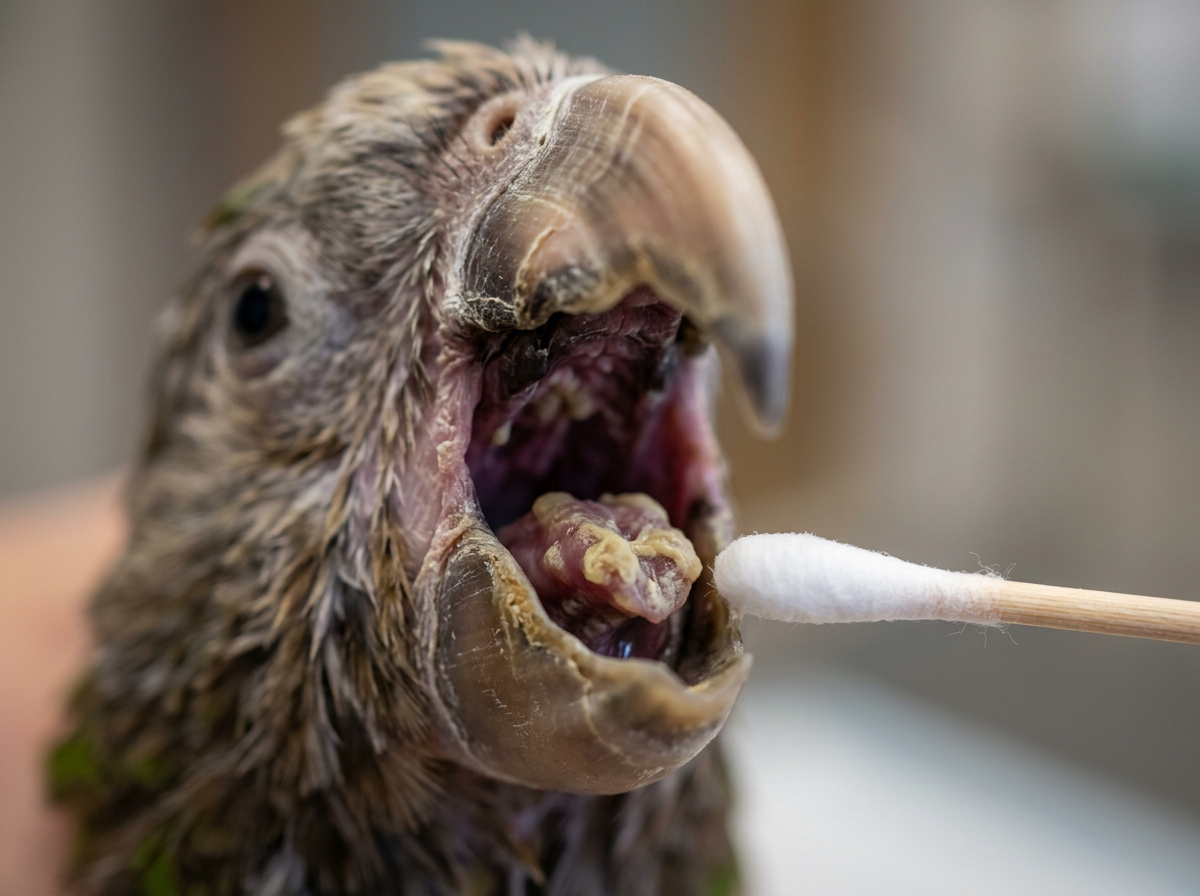
Here is a practical checklist of the most common signs associated with thrush-like infection in birds. You do not need every single one of these to be present, but several together should raise a flag.
- White, off-white, or yellowish patches or plaques inside the mouth, on the tongue, or on the throat lining
- Thick, cheesy, or paste-like deposits that do not wipe away easily
- Redness or inflammation around the beak, mouth lining, or throat
- Swelling inside the mouth or around the beak
- Visible ulcers or sores in the oral cavity
- Unusual or foul-smelling breath (halitosis)
- Excessive drooling or wet, sticky discharge around the beak
- Regurgitation or bringing food back up
- Difficulty swallowing (the bird may tilt its head, stretch its neck, or seem to struggle when eating)
- Reduced appetite or refusal to eat certain foods
- Weight loss, especially noticeable along the breastbone
- Lethargy, fluffed feathers, or general dullness
Not every thrush case looks dramatic. Early on, you might just notice slightly reduced appetite and a faint white coating on the tongue. By the time thick plaques are visible or your bird is clearly struggling to swallow, the infection has typically had some time to develop. Catching it early gives you better options, so if even a few of these signs are present, it is worth a closer look.
How to inspect your bird's mouth safely
Before you do anything, stay calm. Birds pick up on stress quickly, and a panicked inspection can cause more harm than good, especially in a bird that is already unwell. Work in a quiet, well-lit room and keep the interaction as brief as possible.
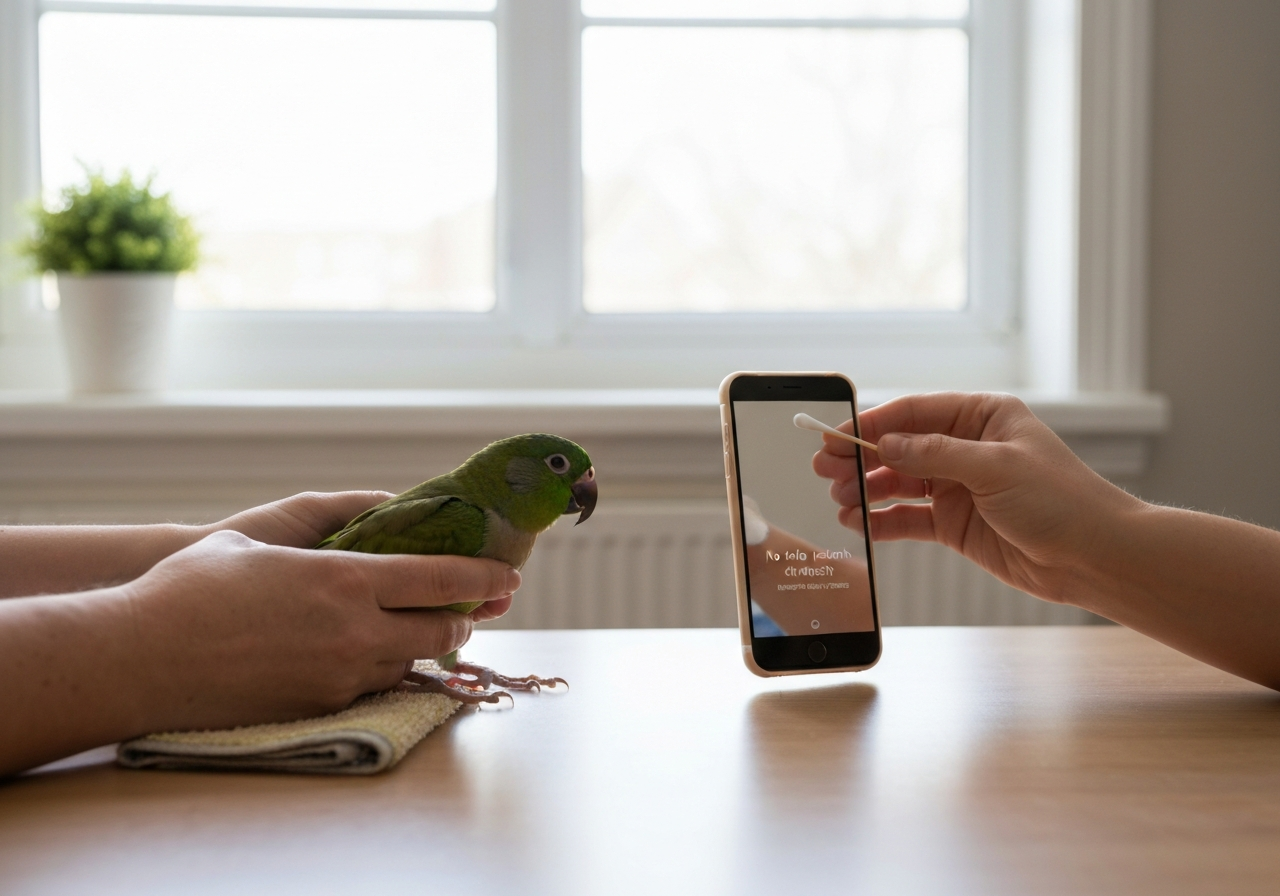
- Wrap your bird gently but securely in a soft towel, leaving just the head exposed. This limits struggling and protects both of you. For smaller birds like budgies or finches, cup them gently in one hand with your thumb and forefinger loosely around the neck, not tight.
- Use a small penlight or phone flashlight held at an angle to illuminate the inside of the mouth. Natural light alone is rarely enough to see clearly.
- Very gently open the beak by applying slight, even pressure at the corners of the beak with your thumb and forefinger. Do not force it. If the bird resists strongly, stop and let a vet handle the examination.
- Look at the tongue, the roof of the mouth (choanal area), the throat, and the inner cheek lining. You are looking for white or yellow patches, unusual texture, redness, swelling, or lesions.
- Note any smell. A sour or yeasty odor coming from the mouth is a common sign of fungal overgrowth.
- Take a quick photo if you can manage it. Even a blurry one can help your vet understand what you are seeing.
- Keep the whole inspection under a minute if possible. Return the bird to a warm, quiet space immediately after.
If your bird is very small, very weak, or already showing breathing difficulties, skip the home inspection and go straight to the vet. Restraining a bird that is struggling to breathe can make things worse fast.
Thrush vs. the look-alikes: how to tell them apart
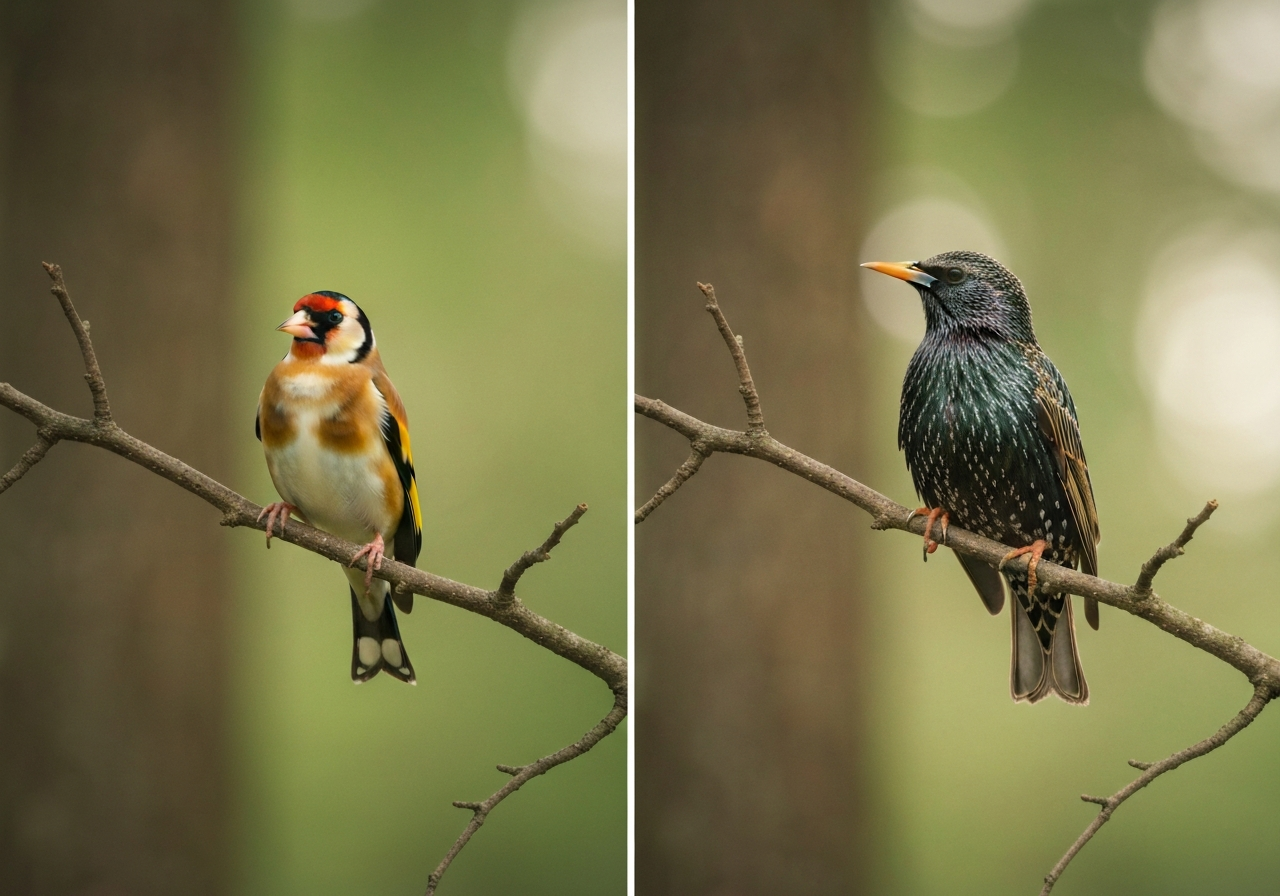
This is where a lot of bird owners get tripped up. White or yellowish lesions in a bird's mouth can come from several different causes, and they can look almost identical to the naked eye. Here is a side-by-side comparison of the most common ones.
| Condition | Appearance | Key Distinguishing Features | Cause |
|---|---|---|---|
| Thrush (Candidiasis) | White to off-white cheesy plaques, thick pseudomembranes on tongue/throat lining | Yeasty or sour odor, may have regurgitation, often associated with antibiotic use or poor diet | Candida yeast overgrowth |
| Canker (Trichomonosis) | Yellow-white cheese-like masses in mouth and esophagus, can be large and invasive | Masses tend to be more solid and adherent, can cause visible swelling in throat/neck; confirmed by microscopy | Trichomonas parasite |
| Wet-form Avian Pox | Yellow to white raised moist lesions in oral cavity, pharynx, and sometimes trachea | Necrotic appearance, may also have skin lesions elsewhere on the body, spread by insects or contact | Avian poxvirus |
| Vitamin A Deficiency | White proliferative plaques or nodules in the mouth and throat | No infectious organism; history of poor diet (seed-only), lesions may look very similar to candidiasis | Nutritional deficiency |
| Physical Injury | Redness, raw tissue, bleeding, or crusting at a localized spot | Usually isolated to one area, no cheesy texture, history of trauma or foreign object | Mechanical injury |
| Bacterial Infection | Redness, swelling, pus, or discharge inside the mouth | Often more localized, may smell putrid rather than yeasty, can occur secondary to injury or other illness | Bacterial overgrowth or abscess |
The honest truth is that you cannot reliably tell these apart at home with just your eyes. The table above gives you a framework, but definitive diagnosis requires a vet, often with a wet-mount microscopy test, culture, or PCR to identify the actual organism. What you can do at home is gather as much observational detail as possible so your vet has a better starting point.
One practical clue: if your bird was recently on antibiotics for another illness and then developed mouth lesions, Candida overgrowth (thrush) becomes more likely because antibiotics can disrupt the normal microbial balance. On the other hand, if your bird is a pigeon, dove, or raptor, trichomonosis (canker) is extremely common in those species and should be high on the list. Birds with seed-heavy diets and no leafy greens or vitamin A sources are more prone to vitamin A deficiency lesions.
Behavioral and health red flags beyond the mouth
Thrush-like infections do not always stay contained to the mouth. The yeast or organism can spread down into the crop and digestive tract, and the symptoms will reflect that. At the same time, some of the warning signs overlap with other serious conditions, so it is important to pay attention to the whole picture.
- Changes in eating habits: a bird that used to eat enthusiastically but now approaches food slowly, takes small amounts, or ignores food entirely
- Weight loss: run your finger gently along the breastbone (keel). If it feels prominent or sharp rather than rounded and padded with muscle, the bird has lost significant weight
- Regurgitation or vomiting: different from normal social regurgitation between bonded birds; look for frequent or involuntary bringing up of food, often with a sour smell
- Head shaking or neck stretching: a sign the bird may be trying to dislodge something uncomfortable in the throat
- Wheezing, clicking, or labored breathing: if the infection has spread to the trachea or respiratory tract, breathing sounds can change
- Open-mouth breathing: a serious sign in birds; they should rarely need to breathe with their beaks open unless it is very hot
- Tail bobbing with each breath: indicates respiratory effort and should prompt an urgent vet call
- General lethargy, sitting low on the perch, fluffed feathers: birds hide illness instinctively, so visible signs of being unwell often mean things have progressed
Any respiratory signs alongside oral lesions deserve particular attention. Wet-form avian pox can affect the trachea, and severe candidiasis can involve the esophagus and crop in ways that interfere with breathing or swallowing. Do not wait and watch if you are seeing breathing changes.
What to do immediately and when it becomes urgent
If you suspect thrush or any oral infection in your bird, here are the practical steps to take right now.
- Do a brief, safe visual inspection as described above and write down or photograph everything you notice.
- Note the history: when symptoms started, any recent antibiotic use, diet details, any recent changes in environment or flock mates, and whether the bird has had any prior health issues.
- Keep the bird warm, calm, and separated from other birds if you have multiple, both to reduce stress and to prevent potential spread.
- Make sure fresh water is available and easily accessible. A bird struggling to swallow still needs hydration.
- Contact an avian vet to book an appointment. Be clear about the symptoms you have observed so they can prioritize appropriately.
- Do not attempt to scrape off the lesions yourself, and do not apply over-the-counter antifungals meant for humans. These can cause additional harm or mask symptoms without treating the underlying cause.
Call or go to an avian vet urgently, same day if possible, if you observe any of the following: open-mouth breathing, tail bobbing, inability to swallow or eat anything at all, visible collapse or extreme weakness, rapid weight loss over a short period, or lesions that appear to be growing or blocking the throat visibly. These are signs the bird cannot wait for a routine appointment.
While you arrange care, the most helpful supportive steps are keeping the environment warm (around 85 to 90 degrees Fahrenheit for a sick bird in a hospital cage if you have one), minimizing handling and stress, offering soft or easily swallowed foods, and maintaining cleanliness in food and water dishes. These steps support the bird without interfering with diagnosis.
What the vet visit and treatment will look like
Your avian vet will likely start with a physical examination, including a direct look into the mouth and throat. For suspected candidiasis, they may take a swab of the lesions for cytology or culture to confirm Candida is present and rule out bacterial infection or other organisms. If you’re wondering what causes bird catcher spots on horses, it’s helpful to compare how different infections and skin conditions can present on animals. For suspected trichomonosis, a wet-mount microscopy (where a fresh swab is examined under a microscope in saline) is a common first step, and PCR testing is available for more precise diagnosis.
If candidiasis is confirmed, antifungal treatment is typically prescribed. Nystatin is one of the most commonly used antifungals for avian candidiasis and works locally in the digestive tract. Fluconazole is another option used in more systemic cases. Treatment duration varies but often runs several weeks, and you will usually need to treat the full course even if the bird looks better sooner.
If trichomonosis is the diagnosis, treatment involves an antiprotozoal medication such as metronidazole or carnidazole. Avian pox has no specific antiviral treatment, so supportive care and preventing secondary infection are the focus there. Vitamin A deficiency is addressed through dietary correction and often supplementation under veterinary guidance.
Your vet will also likely ask about the rest of the bird's diet and environment. Thrush recurrence is common if underlying factors like a seed-heavy diet, chronic antibiotic exposure, or poor hygiene are not addressed. Expect the conversation to include some guidance on long-term prevention, not just treating the current episode. That is genuinely useful information, not just filler. Birds that recover from candidiasis on a corrected diet and clean setup tend to do much better than those that go back to the same conditions.
If you have other birds in the same space, your vet may also want to discuss screening or prophylactic measures, since some of the conditions that cause mouth lesions (particularly trichomonosis) can spread between birds through shared food, water, or direct contact. For more on related conditions involving the throat and beak area, our articles on common white throat bird and common yellowthroat bird symptoms cover additional context that may be useful alongside this guide. common yellowthroat bird common white throat bird
FAQ
Can I tell thrush from other mouth problems just by the color of the spots (white vs yellow)?
It is often safest to assume an infection until a vet rules it out, especially if the lesions are thick or your bird is eating less. If you can, take a clear photo in good lighting and note timing (when you first saw the coating, whether it is spreading). Avoid trying to scrape off plaques at home, because irritation and bleeding can worsen the situation and can make swabs less reliable.
What are early signs I should watch for if the infection is starting?
Yes, thrush can be present even when the bird looks normal at first. Early cases may show only a faint tongue coating and slightly reduced appetite, so the decision should be based on overall behavior (eating, swallowing, drooling, weakness) rather than color alone. When multiple subtle signs show up together, it is worth arranging same-day avian care.
What home treatment is safe while I wait for my vet?
Do not use human mouth products or leftover antibiotics. Some antiseptics, gels, and home remedies can burn delicate mouth tissue or interfere with diagnostic tests. If you need to intervene at home, focus on supportive steps already discussed, keep the cage clean, and offer soft, easy-to-swallow foods while you arrange an avian vet visit.
How should I change feeding if I suspect thrush or trouble swallowing?
If your bird is swallowing poorly, avoid hard seed pieces and anything that can scratch the throat. Offer soft foods your bird accepts, such as finely chopped or softened options, and keep meals frequent but small. If the bird cannot swallow any food or is opening its mouth to breathe, treat it as urgent and go immediately.
When is it better to skip inspecting the mouth at home and go straight to the vet?
If your bird is very small, very weak, or showing any breathing changes, a close-attempt inspection can be risky. Limit handling, use calm observation from a distance, and prioritize urgent vet care. If you do inspect, stop immediately if the bird resists strongly or you notice bleeding.
If treatment starts, when should I expect visible improvement?
Re-checking too early can be misleading. Thrush plaques may look worse before they clearly improve, and different drugs have different response times. Your vet will guide follow-up timing, but a common practical approach is to call for advice if you see no improvement after the first portion of the prescribed course, not just a few days.
Why does thrush come back even after my bird seems better?
Treat recurrence as a systems issue, not just a medication repeat. Common drivers include ongoing diet imbalance (especially low vitamin A sources), frequent antibiotic exposure, and hygiene gaps around food and water dishes. Ask your vet what long-term diet and setup changes will reduce the chance of re-colonization, and plan prevention rather than stopping when symptoms fade.
Can a vet test come back negative even if it looks like thrush?
Test results help, but they can be influenced by timing and sample quality. If a bird was treated recently with antifungals or antibiotics, organisms might not show up the way you expect. This is another reason to tell your vet exactly what was given, when the last dose occurred, and when the mouth lesions began.
Does my bird species change how likely thrush is versus canker?
Yes. Some conditions that resemble thrush are more species-specific, for example trichomonosis is particularly common in pigeons, doves, and raptors. If your bird is in one of these groups, mention that right away so the vet prioritizes appropriate testing.
Should I isolate my bird from other birds if I suspect thrush?
If you have multiple birds, do not assume it is safe to keep them together while one bird has mouth lesions. Candida overgrowth is not the only concern, other infectious causes can spread through shared food, water, and contact. Ask your vet whether to separate birds and whether any screening or sanitation steps are recommended in your household.
Common Yellowthroat Bird ID and Illness Symptom Guide
Learn how to identify the common yellowthroat and use a symptom checklist to spot illness and know when to call a vet.